
Side Dishes
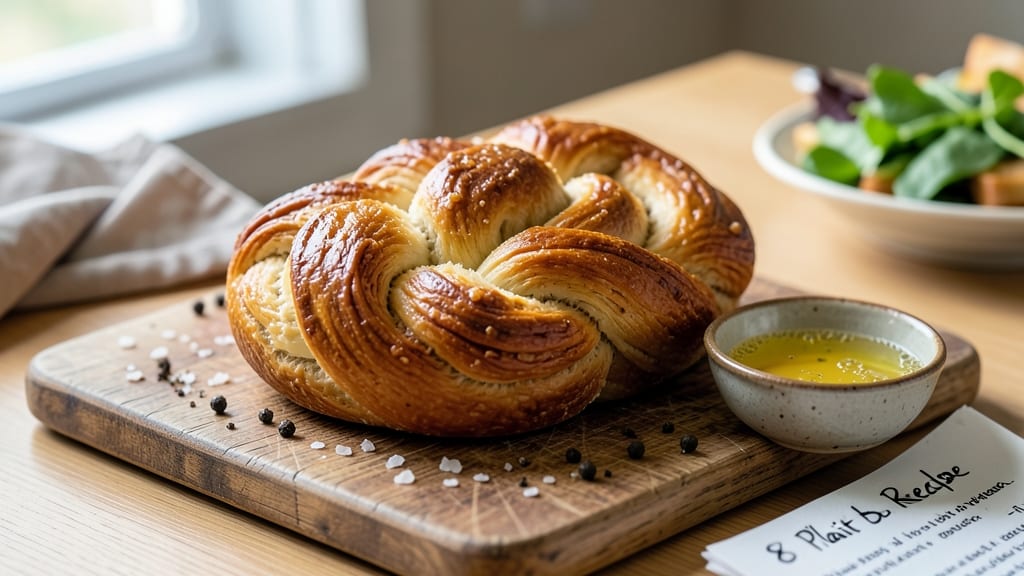
This 8-plait bread recipe delivers a showstopping centerpiece with a crispy golden crown and a tender, fluffy heart—perfect for special occasions or Sunday dinners. 💛 The secret lies in patient dough development and precise braiding, transforming simple ingredients into a stunning, edible masterpiece that rivals bakery displays.
Unlike quick breads, this recipe rewards your time with an aromatic, textured loaf that feels like a celebration in every bite.
The process begins with a rich, slightly sweet dough that needs two hours of proofing to achieve that signature pillowy interior. I’ve refined the method to ensure the braids stay tight and the crust remains crackly without burning.
Whether you’re making it for a holiday table or a casual family meal, the visual impact alone will have everyone asking for seconds. The dough’s natural sweetness from honey or sugar caramelizes beautifully during baking, adding depth to the flavor.
By the time it emerges from the oven, you’ll have a loaf with shatteringly crisp edges and a soft, airy crumb that melts in your mouth. The braided design isn’t just decorative—it creates pockets of steam that keep the bread moist for hours.
Serve it warm with butter, jam, or alongside soups to soak up every last drop of flavor. This isn’t just bread; it’s an experience.
For those who love cultural twists, try adding cardamom for a Middle Eastern-inspired sheermal or a touch of orange zest for a citrusy Italian treccia.
The beauty of this recipe is its versatility—elevate it with a simple egg wash for extra shine or keep it rustic with a sprinkle of coarse sugar. Let’s get baking!
Ingredients for 8 plait bread
Eight plaits, one stunning loaf—start with these essential ingredients for a bakery-worthy centerpiece.
| Ingredient | Amount | Notes |
|---|---|---|
| All-Purpose Flour 🌾 | 6 cups | Spooned and leveled, not packed |
| Active Dry Yeast 🍞 | ¼ oz | Or 2 1/4 tsp, one packet |
| Granulated Sugar 🍚 | ¼ cup | For dough feeding and caramelization |
| Unsalted Butter 🧈 | ½ cup | Cold, cut into cubes (80°F room temp) |
| Large Eggs 🥚 | 2 whole | Room temperature for even mixing |
| Warm Water 💧 | 1 ¼ cups | 110°F, not boiling |
| Salt 🧂 | 1 ½ tsp | Diamond Crystal kosher preferred |
| Honey 🍯 | 2 tbsp | For natural sweetness and moisture |
| Vanilla Extract 🌸 | 1 tsp | Pure, not imitation |
| Egg Wash 🥚 | 1 whole | 1 egg beaten with 1 tbsp water |
| Coarse Sugar 🍚 | ¼ cup | For final crust decoration |
| Olive Oil 🫒 | 1 tbsp | For greasing bowl and braids |
The flour is your foundation—King Arthur or Gold Medal work best for their high protein content, giving that perfect chew. Yeast is non-negotiable here; Fleischmann's or Saf-Instant both deliver reliable rises. For the butter, Land O'Lakes or Plugrá brands provide consistent fat content without excess water. Keep everything cold until the final knead—room temperature butter and eggs ensure smooth dough without overworking it. The honey should be raw and liquid (avoid crystallized), and if you're feeling adventurous, Manuka honey adds subtle depth. Vanilla extract? Nothing imitation—the real stuff makes all the difference in that final aromatic punch.
No active dry yeast? Instant yeast works at half the amount—just toss it directly with the flour. Short on butter? Vegetable shortening keeps the same structure, though flavor will differ slightly. The eggs can be replaced with 2 tbsp melted coconut oil + 2 tbsp milk in a pinch, though texture may be slightly denser. For the sugar, maple syrup swaps 1:1 for honey, but reduce other liquids by 1 tbsp to balance moisture. The coarse sugar topping? Turbinado sugar is ideal, but raw cane sugar works too—just pulse it briefly in a food processor for even coverage. And if you're baking in a dry climate, add 1 tsp milk to the egg wash to help the crust brown beautifully.
This dough is a patient one—proof it in a warm (78°F) spot for maximum rise. Store shaped loaves in the fridge overnight for even better flavor development. The finished bread keeps at room temperature for 2 days wrapped in a clean kitchen towel, but it's best enjoyed fresh. For longer storage, slice and freeze portions—they reheat beautifully in a 350°F oven for 5-7 minutes. The braided design holds up well for 3 days if kept in an airtight container, though the crust will soften slightly. Pro tip: Brush warm slices with melted butter right out of the oven for that bakery-fresh experience.
Why You'll Love This Recipe
- No-Knead Magic: I swear by this dough—just mix, let it rise, and shape. The yeast does all the work while I sip coffee, and those plaits? They come together faster than you’d think for something that looks so impressive.
- Buttery Sweet Payoff: That touch of sugar in the dough caramelizes just enough to give it a subtle richness, while the butter makes every bite melt-in-your-mouth. Honestly, the first time I tried it, I nearly ate the whole batch raw.
- Weeknight to Party: Same dough, endless uses. Toast it for breakfast, serve it warm with soup, or freeze the leftovers for lazy mornings. Between us, I’ve even used it as a base for garlic butter sandwiches—no judgment.
- Pantry Staple Power: Flour, yeast, sugar, butter, eggs—you’re probably missing one of these right now. If you already have them, this recipe costs pennies to make and stretches into three meals. My wallet and I are forever grateful.
Step-by-step instructions for crispy braided bread
Here's how to craft that perfect golden crown with a soft, pillowy interior.
👨🍳 Step 1: Activate the Yeast and Mix the Dough
In a large bowl, combine the 1.25 cups warm water (about 110°F) with the 0.25 cup granulated sugar and 0.25 oz active dry yeast. Let sit for 5-10 minutes until foamy—this confirms your yeast is alive and ready to work. If it doesn't bubble, start over with fresh yeast.
Add the 6 cups all-purpose flour and 1.5 tsp salt to the bowl. Using a wooden spoon or dough whisk, mix until a shaggy dough forms. Then add the 2 whole large eggs, 2 tbsp honey, and 1 tsp vanilla extract. Mix until combined, then turn onto a lightly floured surface and knead for 8-10 minutes until smooth and elastic.
🥘 Step 2: First Rise and Prepare the Dough
Place the dough in a lightly oiled bowl, cover with a damp towel, and let rise in a warm place for 1-1.5 hours or until doubled in size. The dough should spring back slowly when poked—this indicates proper fermentation. If your kitchen isn't warm, place the bowl near a turned-off oven with the light on.
Once risen, punch down the dough to release air, then divide it into 3 equal pieces. Roll each piece into a 12-inch log, tapering the ends slightly. Here's the thing—don't worry if they're not perfect. The braiding will give you that classic look even if the logs aren't uniform.
🔪 Step 3: Braid and Second Rise
Arrange the 3 logs side by side. To braid, take the right log and cross it over the middle, then bring the left log over the new middle. Repeat this motion, alternating sides, until you've used up all the dough. Tuck the ends under the braid to secure it. Place the braid on a parchment-lined baking sheet, cover loosely with plastic wrap, and let rise for 30-45 minutes until puffy.
While waiting, preheat your oven to 375°F. Brush the braid with the 1 whole egg wash (1 egg beaten with 1 tbsp water) and sprinkle evenly with the 0.25 cup coarse sugar. This creates that signature caramelized crust. Don't skip this step—it's what gives you that crispy crown.
🔥 Step 4: Bake to Golden Perfection
Bake for 25-30 minutes until the bread reaches an internal temperature of 190-200°F and the top is deep golden brown with caramelized sugar spots. Here's where it gets tricky—rotate the pan halfway through baking for even browning. The bread is done when it sounds hollow when tapped on the bottom.
Remove from the oven and let cool on a wire rack for at least 15 minutes before slicing. This resting period is crucial—it allows the steam to escape and the crumb to set properly. If you cut too soon, the bread will be gummy inside. The result should be a crispy, caramelized exterior with a soft, pillowy interior that's perfect for sandwiches or serving with butter.
Pro Tips For Making 8 Plait Bread
- Weigh Your Butter: That stick measurement? Forget it. Use a kitchen scale for the butter—8 plait bread relies on precise ratios, and eyeballing softens butter means your dough will be inconsistent. I learned this the hard way when my first batch turned out greasy and dense. For this recipe, aim for 226 grams of unsalted butter, cold but pliable—like a slightly squishy stress ball.
- Let the Yeast Bubble: Skip the warm water test—just proof your yeast in the dough itself. Mix the yeast with the sugar and a splash of warm milk (or water) from the recipe, then let it sit for 5–10 minutes until it’s frothy and smells like fresh bread. If it doesn’t, your yeast is dead, and no amount of kneading will save you. Trust me, I’ve wasted dough trying to force it.
- Shape Loosely First: Don’t stress the plaits until the dough is fully relaxed. After the first rise, gently shape the dough into a rough rectangle, then fold it into thirds like a letter. This eases tension, so when you finally braid it, the strands hold without snapping. I used to pull too tight too soon—now I wait, and the bread stays intact.
- Chill Before Baking: Pop the shaped loaf in the fridge for 30 minutes before baking. Cold dough rises slower, giving you more control over the final shape, and it bakes with a tighter crumb. I was skeptical until I tried it—now my plaits stay neat, and the crust gets that perfect golden sheen without burning. (Yes, even if you’re impatient like me.)
Best sauces and condiments for 8 plait bread
Classic Butter Spread
Nothing beats a simple cold butter spread for this bread—just soften ½ cup unsalted butter (like Land O'Lakes) to room temperature, then mix with 1 tbsp honey and a pinch of flaky sea salt. The honey enhances the bread's natural sweetness while the salt balances the richness.
I like to add ½ tsp vanilla extract for an extra aromatic touch. Serve this with warm slices straight from the oven for that bakery-fresh experience. 🧈
Honey-Lavender Glaze
For a floral twist, whip together ¼ cup melted butter, 2 tbsp honey, and ½ tsp culinary lavender (from Penzeys Spices). Brush this glaze over slices while still warm to create a fragrant, sticky finish.
The lavender pairs beautifully with the bread's vanilla notes, adding a sophisticated touch without overpowering. Store any leftover glaze in an airtight container for up to 1 week. ✨
Spiced Whipped Cream
Whip ½ cup heavy cream with 1 tbsp powdered sugar, ½ tsp cinnamon, and ¼ tsp cardamom for a light, aromatic topping. This works especially well with the Middle Eastern-inspired sheermal variation of this bread.
Pipe or dollop onto slices alongside jam or fresh fruit for a dessert-like treat. Keep the whipped cream chilled in an airtight container and whip just before serving. 🌸
Garlic-Herb Oil
Infuse ½ cup olive oil (like California Extra Virgin) with 3 minced garlic cloves, 1 tbsp chopped fresh rosemary, and 1 tsp flaky salt. Heat gently for 5 minutes, then strain.
Drizzle over warm bread slices alongside burrata cheese or prosciutto for a savory-sweet contrast. Store the infused oil in a dark glass bottle in the fridge for up to 2 weeks. 🫒
Citrus Zest Compote
Simmer ½ cup orange juice, 2 tbsp honey, and 1 tbsp grated orange zest until slightly thickened (5-7 minutes). Finish with 1 tbsp fresh mint, chopped.
This bright, tangy compote cuts through the bread's richness and complements the citrusy Italian treccia variation. Store in an airtight container for up to 5 days in the fridge. 🍊
Nutty Almond Butter
Spread ¼ cup almond butter (like Justin's) on toasted slices and top with thin apple slices or cinnamon. The nutty depth pairs perfectly with the bread's buttery, honey-sweetened notes.
For extra crunch, sprinkle with toasted sliced almonds. Store almond butter in its original airtight container and keep refrigerated. 🌰
Nutrition facts
Frequently asked questions
Why does my braided bread look flat after baking?
The most common reason is underproofing. The dough needs 1-1.5 hours for the first rise and 30-45 minutes for the second rise after braiding. If your kitchen is cold, place the bowl near a turned-off oven with the light on to create warmth. Also, ensure your yeast is fresh—old yeast won't activate properly, leading to a dense loaf.
Can I make this bread without a stand mixer?
This recipe is designed for hand-kneading. After mixing the ingredients, turn the dough onto a lightly floured surface and knead for 8-10 minutes by pushing, folding, and turning the dough until it's smooth and elastic. The key is patience—don't rush it, or the gluten won't develop properly. A little elbow grease goes a long way!
How do I fix a cracked crust before baking?
If your braided loaf develops cracks during the second rise, gently press them back into place with your fingers. For extra shine and crispiness, brush the cracks with a little beaten egg wash before sprinkling the coarse sugar. This will help create a more even, golden finish. Just avoid overhandling the dough, as this can deflate the braid.
What’s the best way to store leftover braided bread?
Wrap the cooled loaf tightly in a clean kitchen towel or aluminum foil, then place it in an airtight container. At room temperature, it stays fresh for 2-3 days. For longer storage, slice the bread and freeze portions in a freezer bag. Reheat slices in a 350°F oven for 5-7 minutes until warm and crispy. Avoid the microwave—it makes the bread gummy.
Can I add nuts or dried fruit to this dough?
Yes, but add them carefully to avoid overloading the dough. Fold in ½ cup chopped nuts (like walnuts or pecans) or ¼ cup dried fruit (such as cranberries or raisins) during the final kneading stage. Keep portions small—too much filling can weigh down the braids and prevent proper rising. For extra flavor, toast the nuts first and toss them in a little honey or cinnamon before mixing.